JUNE 24, 2026
How One Pharmaceutical Manufacturer Modernized Predictive Maintenance with Online Condition Monitoring
NEWARK, DELAWARE

Introduction
Some of the most critical assets in pharmaceutical manufacturing don’t run continuously. Batch equipment, standby pumps, and hard-to-reach air handling units may sit idle during scheduled inspection routes, leaving months-long gaps in machine condition data.
At one pharmaceutical manufacturing site, this created a clear reliability challenge. Vibration analysis was subcontracted to a third party and data was manually collected on a quarterly basis. While the program provided useful insights, it also meant some machines went six to nine months without a single vibration reading simply because they weren’t operating when the route took place.
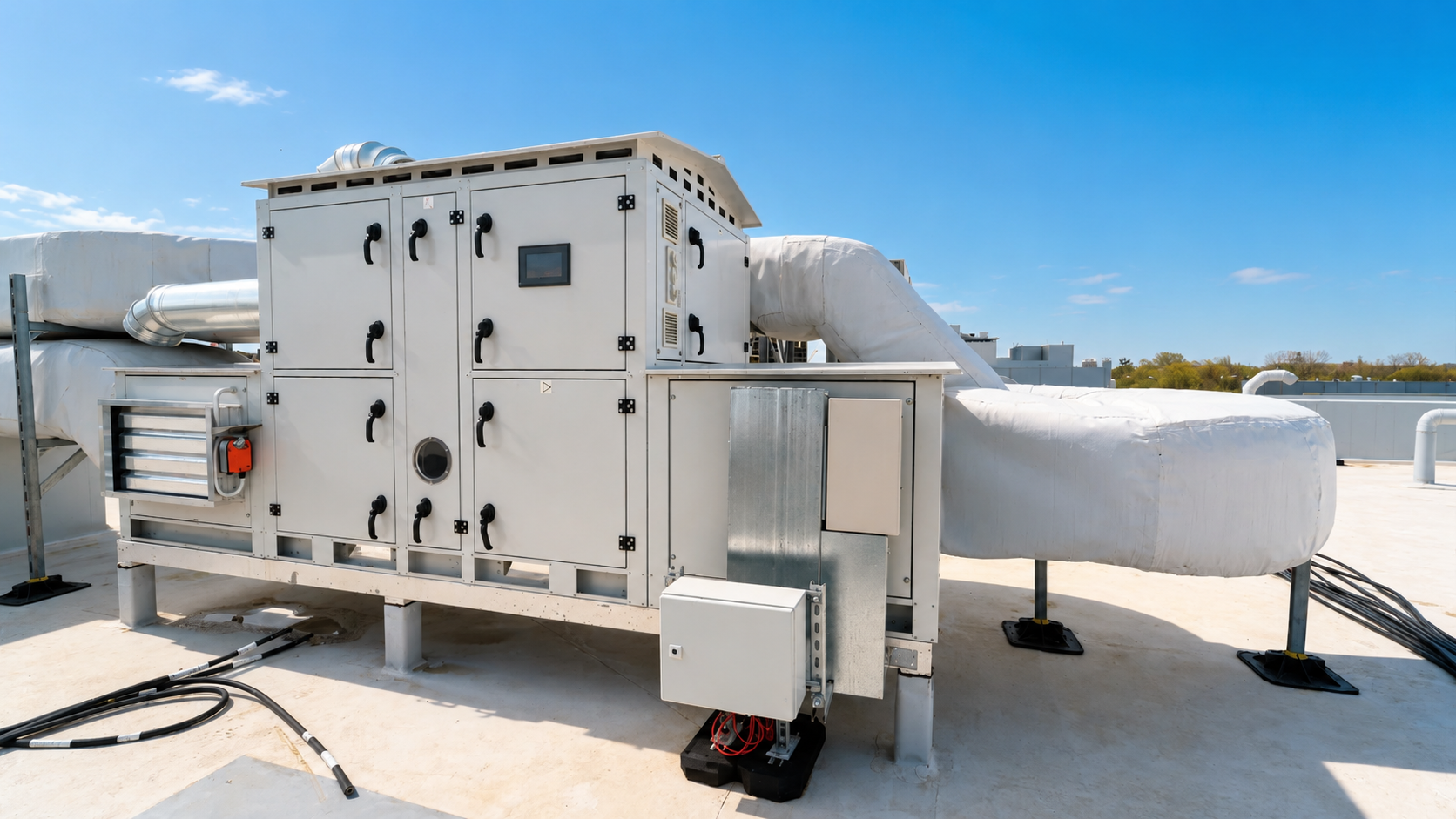
The site had already invested in accelerometers and BNC junction boxes across the facility, but the data wasn’t being used for real-time decision-making. Rather than replace that infrastructure, the team wanted a modern monitoring system that could build on what was already in place while expanding coverage to difficult assets like air handling units (AHUs).
To close the gap, the team turned to Petasense for a hybrid condition monitoring approach that could connect existing wired sensors, add wireless vibration monitoring where needed, and deliver actionable insights in real time.
Enhancing What Already Worked
The site team did not want to replace infrastructure that was already in place. Accelerometers and BNC junction boxes had already been installed across parts of the facility, including hard-to-reach areas such as air handling units (AHUs). The goal was to make better use of that existing setup while expanding coverage to assets that had not previously been monitored.
Petasense Transmitters were used to connect the existing wired sensors into the monitoring system, while Wireless Vibration Motes were added to equipment such as fans and pumps where new coverage was needed. This allowed the site to combine legacy instrumentation with wireless monitoring instead of relying on a single approach.
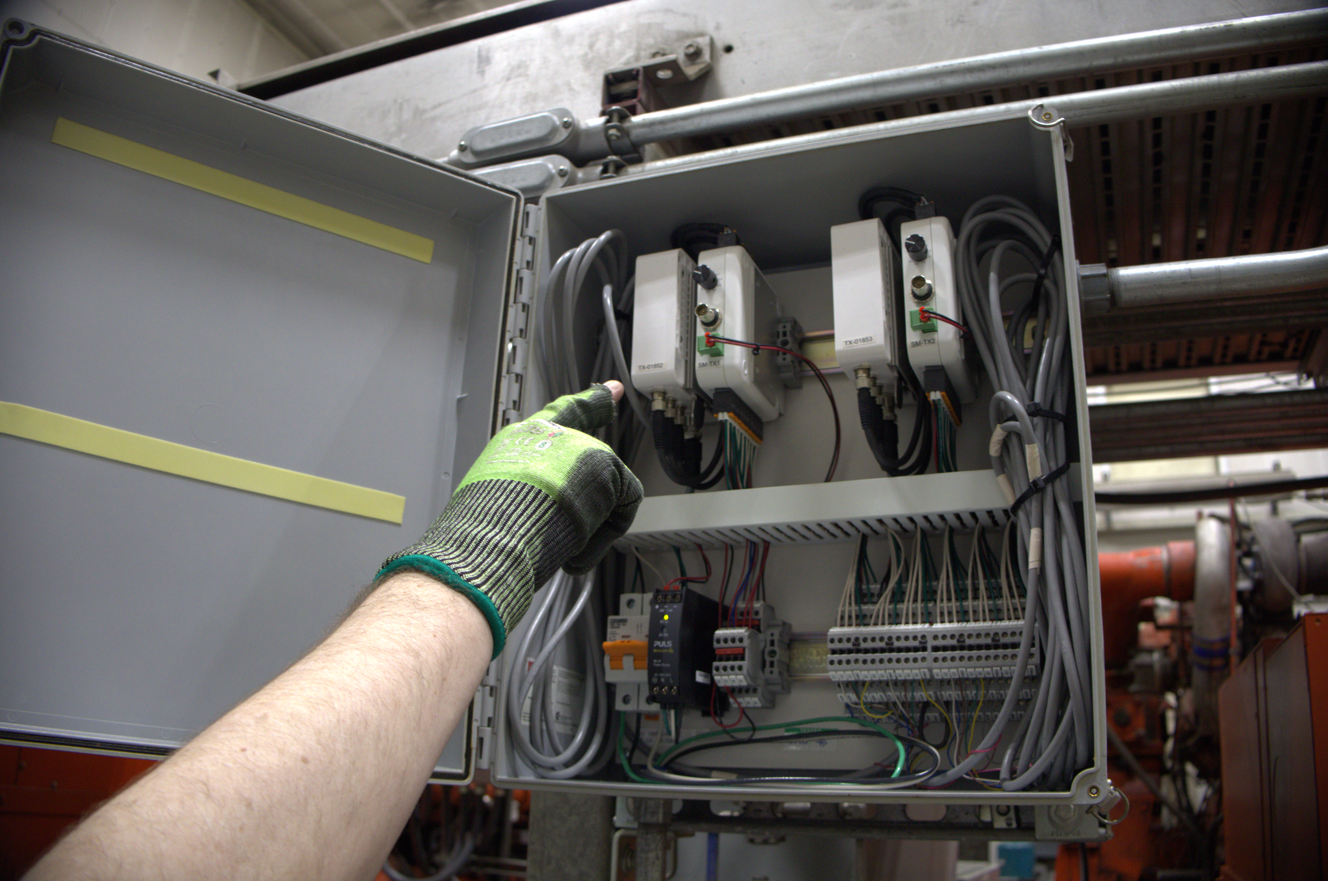
With this hybrid setup, the team could collect triaxial vibration, temperature, and running speed data several times a day. Compared to quarterly manual routes, the system provided a more consistent view of equipment health and helped close the data gaps that had previously limited the program.
Implementation and Ongoing Review
The rollout included hardware installation, software configuration, and coordination between the site’s maintenance team and Petasense analysts. Once the system was online, regular review meetings helped the team evaluate equipment condition, confirm system health, and prioritize assets that needed attention.
As data began coming in several times a day, the maintenance process also changed. Instead of waiting for the next quarterly route, potential issues could be reviewed as they appeared in the data. Petasense analysts reviewed vibration trends, spectra, and waveforms to help identify likely fault conditions and provide recommended next steps.
The site maintenance team then used those findings to investigate equipment in the field and determine whether corrective action was needed. In many cases, this helped move maintenance planning from a periodic review cycle to a more active process where issues could be identified, evaluated, and addressed much sooner.
Case Study 1: Diagnosing Bearing Fluting
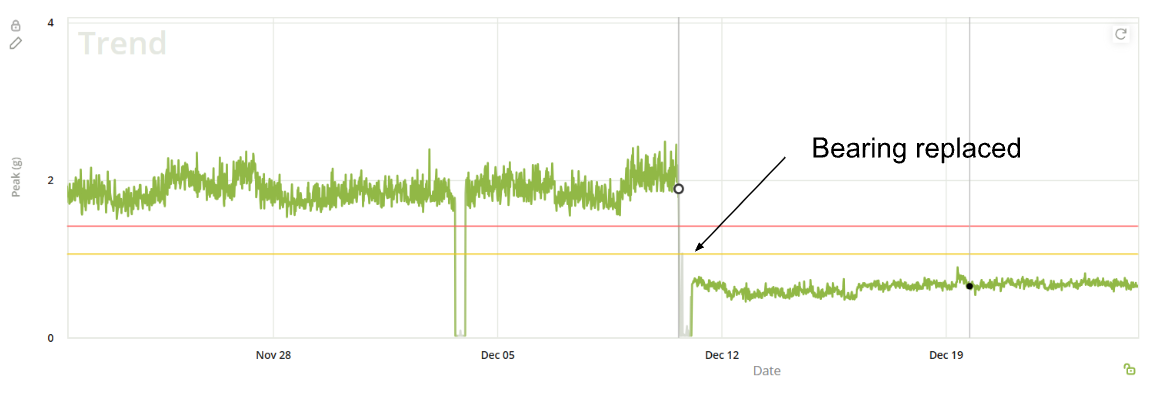
Soon after implementation, abnormal vibration levels were detected on a return fan within one of the air handling units (AHUs). A closer review of the acceleration spectrum showed elevated activity in the 4 to 10 kHz range, which indicated a potential bearing issue. The demodulated spectrum provided additional evidence, showing the bearing defect frequency and related harmonics.
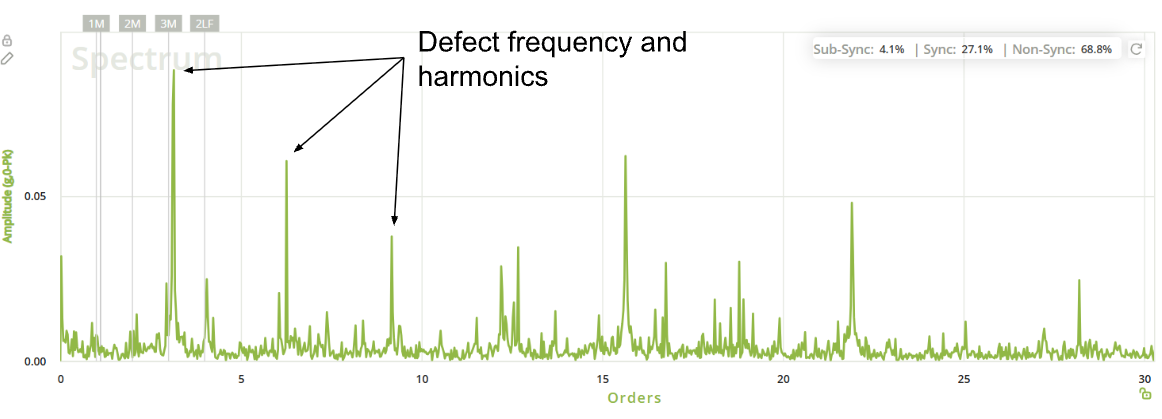
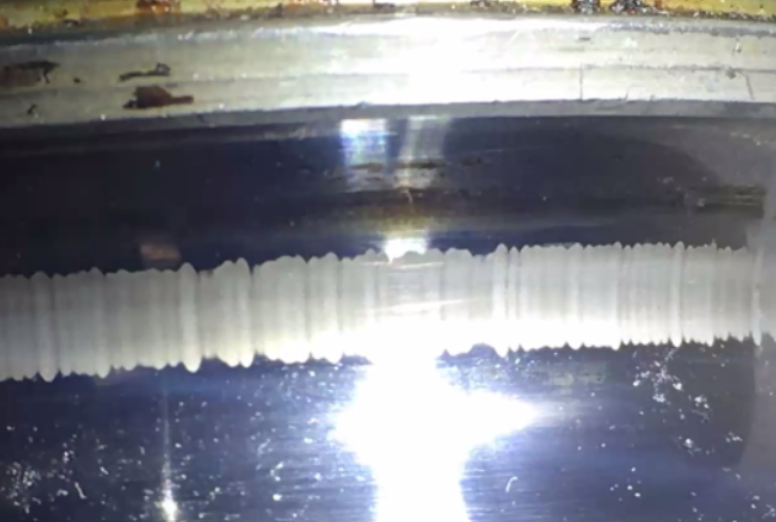
This pattern was consistent with bearing fluting, a condition caused when stray electrical currents pass through the bearing and create small pits along the raceways. Over time, this damage can lead to increased vibration, noise, and reduced bearing life.
Based on the analysis, the maintenance team scheduled corrective action. During the repair, the damaged bearing was replaced, and inspection of the old bearing showed visible fluting marks on the raceways. The team also grounded the motor casing to the frame and completed shaft alignment and balancing before returning the fan to service.
After the repair, vibration levels returned to a stable range. By identifying the issue before failure, the team was able to address the problem as a planned maintenance activity rather than an unexpected equipment outage.
Case Study 2: Identifying Imbalance Across Multiple Fans
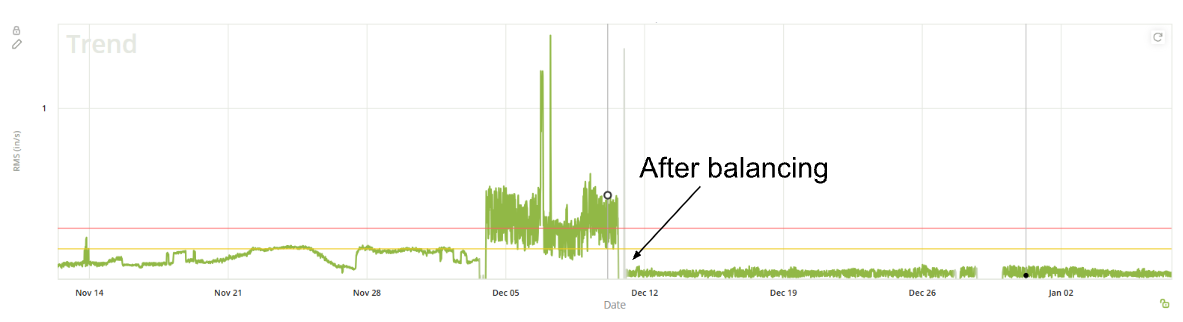
Several air handling unit (AHU) return fans began showing gradually increasing vibration levels over time. As the trends moved above the established alarm thresholds, the data was reviewed in more detail to understand the cause.
The vibration spectra showed elevated amplitudes at running speed, also known as 1X, across all three fans. This pattern was consistent with fan imbalance, where uneven mass distribution causes vibration once the fan is in operation.
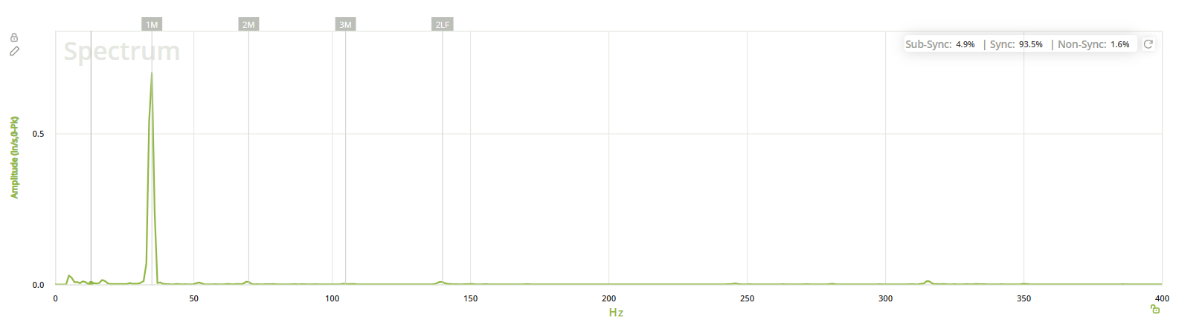
Based on the analysis, the maintenance team performed dynamic balancing on the affected fans. Follow-up measurements showed that overall vibration levels returned to acceptable limits, with the 1X amplitudes significantly reduced.
By addressing the imbalance across multiple fans, the team was able to correct a developing reliability issue before it led to additional stress on bearings, shafts, and support structures.
Case Study 3: Identifying a Faulty Bearing on an Exhaust Fan Motor
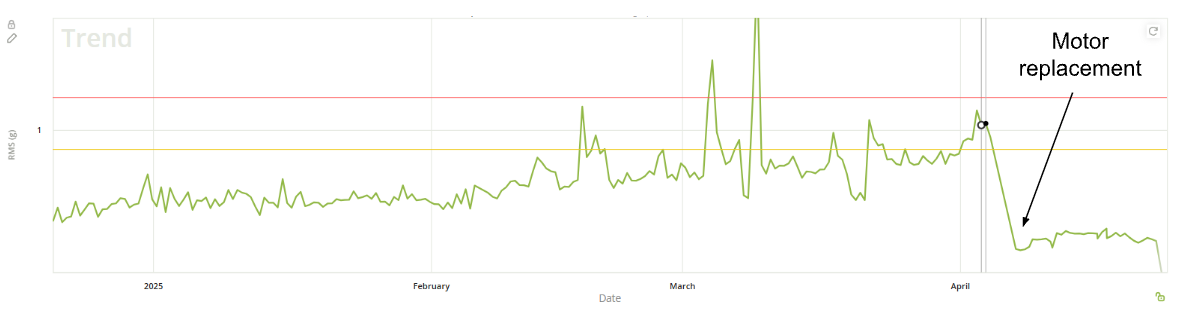
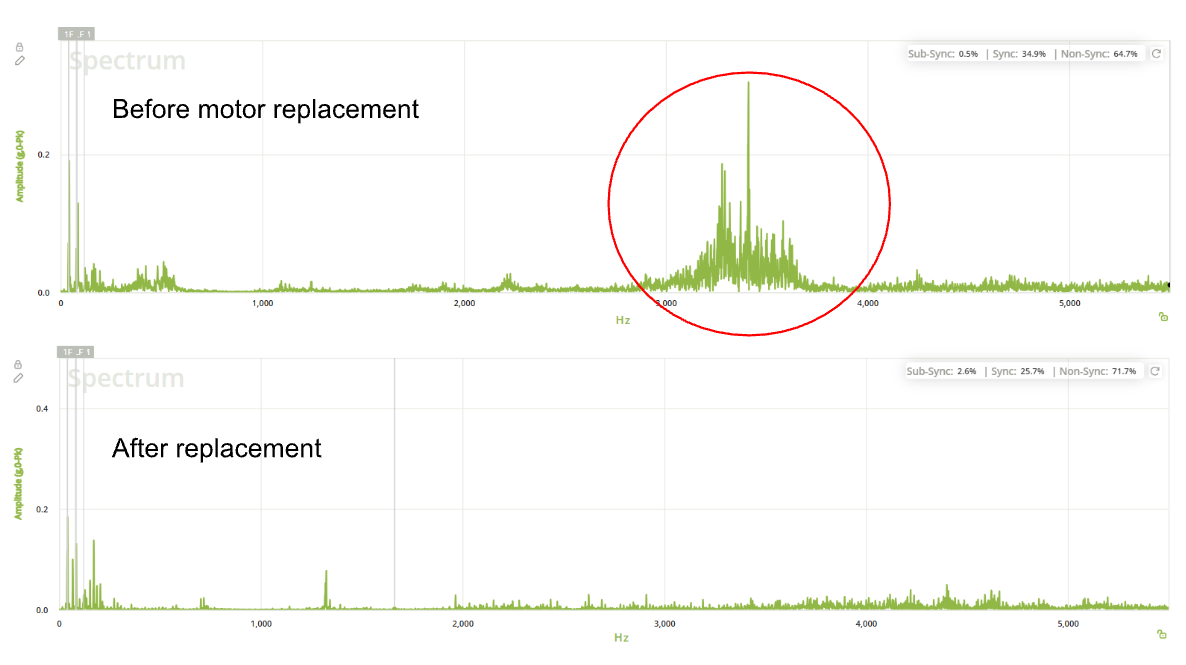
A critical exhaust fan began showing a steady rise in overall acceleration levels, eventually reaching more than twice its baseline. A closer review of the vibration spectrum from the fan motor showed a broadband increase in the high-frequency range between 3 and 4 kHz. This pattern was consistent with early-stage bearing damage, such as lubrication breakdown or surface wear.
Based on the analysis, the maintenance team decided to replace the fan motor rather than repair only the bearing. Given the labor required for a bearing rebuild, a motor replacement offered a faster and more practical path to restore the asset.
Inspection of the removed bearing showed damage consistent with the vibration findings. After the motor was replaced, follow-up readings showed a significant reduction in both overall acceleration and high-frequency vibration content.
By identifying the issue early, the team was able to address the bearing problem through planned maintenance before it developed into a more disruptive equipment issue.
Looking Ahead
The site continues to expand its predictive maintenance program by building on infrastructure that was already in place. Instead of replacing existing accelerometers and junction boxes, the team has been able to connect more of those sensors into a continuous monitoring system while adding wireless vibration sensors where additional coverage is needed.
This approach has helped the team move beyond a manual, route-based program toward a more consistent monitoring workflow. Equipment condition can now be reviewed more frequently, issues can be evaluated as trends develop, and maintenance decisions can be made with more current data.
Looking ahead, the site plans to continue expanding coverage across additional assets using the same hybrid approach of wired and wireless monitoring.
 Thanks for subscribing - stay tuned for our next newsletter